
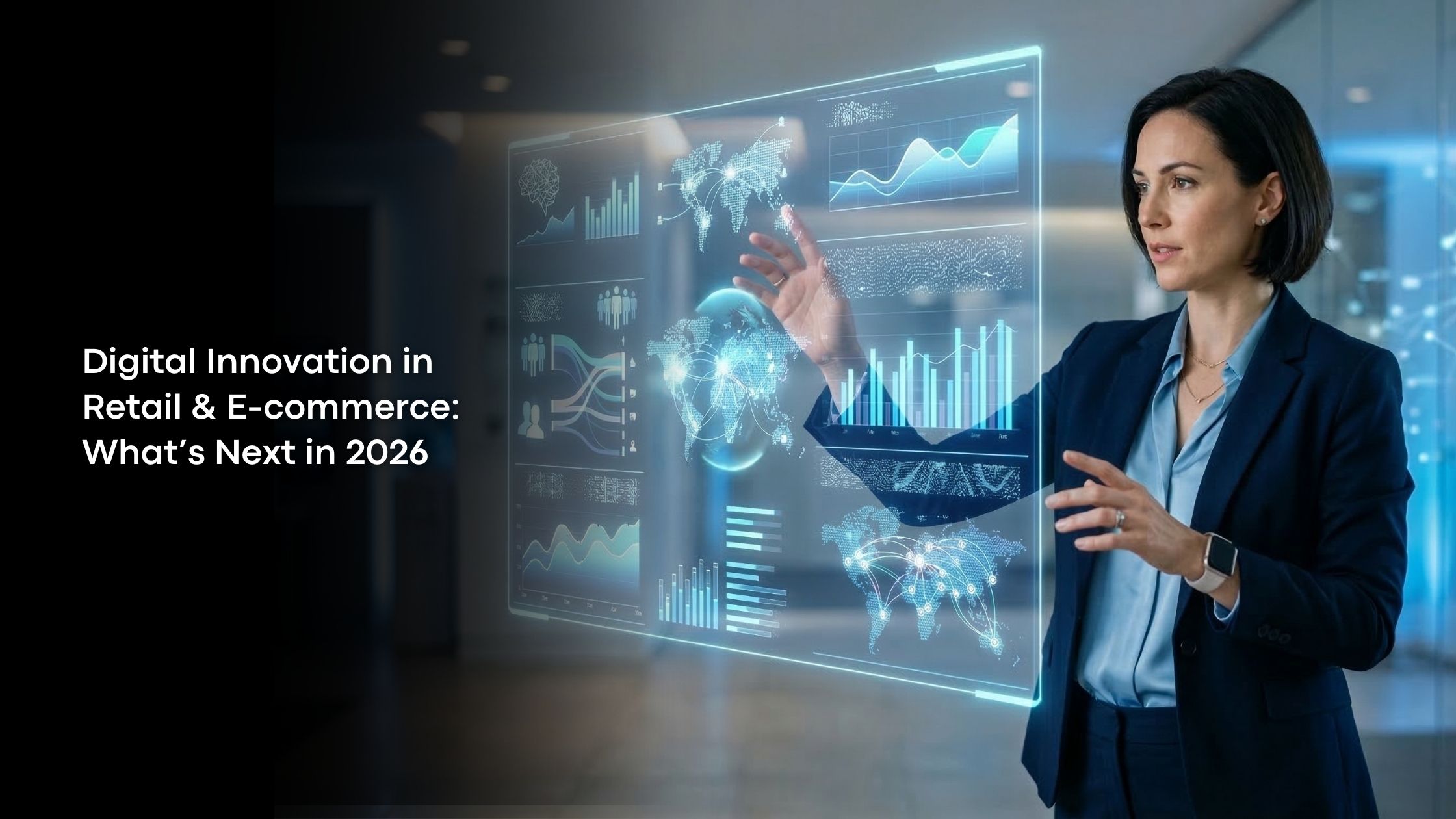
In 2026, the retail and e-commerce landscape is evolving rapidly. Technologies such as artificial intelligence, immersive shopping tools, blockchain infrastructure, and sustainable supply chains are transforming the way businesses operate and how customers shop. Global e-commerce sales are expected to reach around $4.94 trillion in 2026, which is more than 12 percent higher than in 2025.
In today’s competitive market, retailers can no longer rely solely on conventional online stores. Instead, they need to adopt more advanced digital strategies to stay ahead.
Retail Digital Innovation 2026 highlights important developments such as hyper-personalized shopping experiences and smart stores powered by IoT technologies. These innovations are becoming key drivers of growth in the modern retail ecosystem.
Continue reading to learn about digital innovation in retail and e-commerce and what to expect in 2026.
AI-Driven Personalization
Retail innovation has taken on a new form of artificial intelligence that is used to enhance customer interactions and operational effectiveness. AI systems can be used to analyse customer data, including their browsing history, buying habits, and preferences, to provide exceptionally personalised recommendations of specific products. Another application of AI in retailers is demand forecasting, automated pricing, and visual search. These factors all lead customers to find products by uploading photos alone.
When it comes to retail digital innovation 2026, it is estimated that almost 87% of retailers will make use of AI in at least one business operation, and many will continue to invest more in AI technologies.
The rise of AI shopping assistants is a significant trend that can use the capabilities of browsing the catalogue, comparing prices, and even making purchases on behalf of consumers. Such innovations represent some of the most practical retail-specific AI use cases, showing how AI technologies are improving the shopping experience and helping customers make faster, more convenient decisions.
Immersive AR, VR, and Metaverse Experiences
AR and VR are revolutionising product interaction between a consumer and a product over the internet. Customers are now so happy with the e-commerce digital transformation as they can now try out products virtually using visual integrations and 3D images instead of just using pictures. Retailers in fashion give the customer a chance to check how things fit them. On the other hand, furniture retailers give them a chance to view things from the comfort of their homes.
Immersive commerce is growing by 2026 by way of metaverse experiences in which buyers go through digital shops, touch products in 3D, and get computer-generated suggestions. These technologies would make the customer more confident and lower the rates of returns through more realistic product experiences.
Blockchain and Supply Chain Transparency
Supply chain transparency has been a growing issue of concern to both retailers and customers. The blockchain technology offers a reliable record of product flow throughout the supply chain, which is difficult to alter. Integrated with Internet of Things (IoT) sensors, blockchain will be able to trace the packages and track the storage environment, along with checking the authenticity of a product.
The retailers will enjoy e-commerce digital transformation elements such as enhanced inventory control, lower fraud, and enhanced visibility of the supply chain. AIs are also being integrated with blockchain platforms by 2026, with effectively the retailers simulating the supply chain operations and predicting disruptions ahead of time and preventing them.
Social and Voice Commerce Boom
Social media sites have become effective e-commerce platforms. Rather than directing customers to other websites, platforms are creating products that enable customers to browse and buy within the app, as well as with the help of influencers and micro-creators who showcase the products in short-form videos and live streams.
Simultaneously, voice commerce is expanding, as well as the popularity of smart speakers and voice assistants. Voice recognition helps consumers to find products, reorder the essentials, and monitor deliveries with a few words. Voice-enabled kiosks, which can help shoppers with suggestions on the products and orientation around the stores, are also becoming popular at retail stores.
Sustainability and Regulatory Shifts
Global retailers are increasingly becoming interested in sustainability as governments present more demanding environmental policies. Consumers now choose brands that are more focused on environmentally friendly production, ethical sourcing and transparent supply chains. The retailers are reacting through sustainable packaging, energy-efficient logistics and circular economy models.
The customers are also practising a lot of sustainable efforts in order to make this world a better place. As the future is all about digital innovations, these practices are a blessing for the generations to come.
Omnichannel and 5G-Powered IoT
Omnichannel retail is emerging as the new practice of offering convenient shopping experiences in online and mobile stores as well as physical shops. Customer data, inventory systems, and marketing tools are combined by retailers so that they can have coherent interaction channels at all touchpoints. Customers, with the help of e-commerce digital transformation, are able to look at the status of products online, place orders to collect at the store premises or get individual promotional offers based on their tastes and preferences.
Smart retail technologies are driven by IoT devices, which are becoming increasingly fast as a result of the expansion of 5G networks. The use of smart shelves, automatic checkout, and continuous monitoring of the inventory helps in making the stores more efficient and convenient for customers. These innovations assist the retailers in minimising the cost of operation and provide a faster and personalised service.
Challenges and Opportunities Ahead
With high technological development, retailers are still facing various challenges, such as the following.
- Inflation
- Supply chain
- Tariff
- Strict data privacy laws
To ensure customer trust, businesses have to invest in safe data infrastructure and conscientious AI practices. To deal with safe data infrastructure and offer customers real-time values, businesses now consider cloud technology in retail to meet the demands.
Nevertheless, these challenges have opportunities too. Businesses that embrace digital transformation, automobile and data insights on customers will have an advantage. In the case of an emerging market such as India, digital-first D2C brands could use AI tools, visual search, and social commerce to grow internationally and find new customers.
Wrapping It Up
Modern innovations have become a major driving force in the retail industry, benefiting both businesses and customers. As technology continues to evolve, retailers can improve operations while creating better shopping experiences for their customers.
If you are looking to transform your retail business, consider connecting with SiRA Consulting for effective customer experience optimization strategies. Our team helps businesses implement modern solutions that enhance customer interactions and deliver measurable results.