
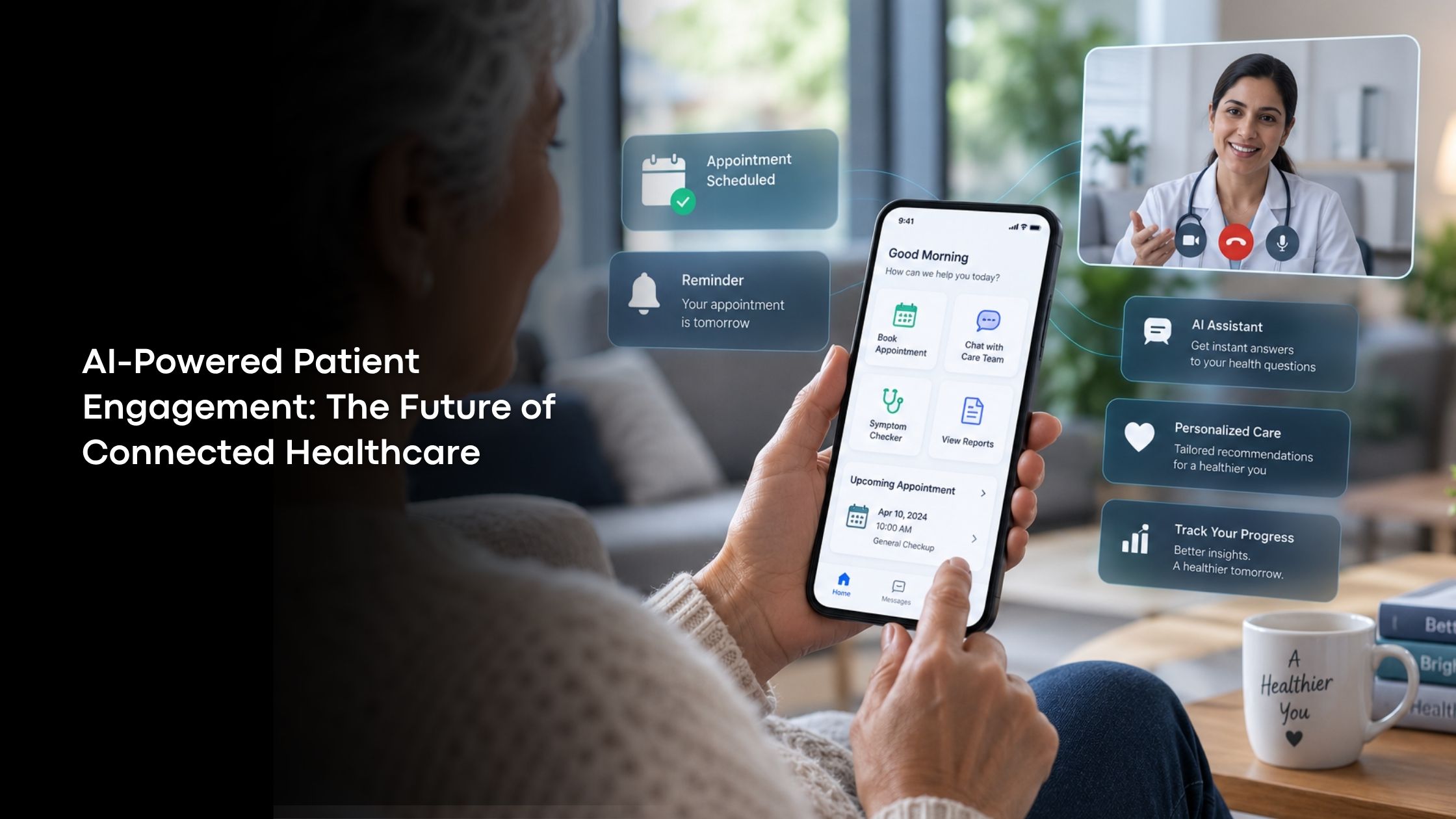
Imagine getting notified before missing your appointment. Imagine getting an immediate answer whenever you have a health question for your healthcare provider. That’s how patient engagement using AI will transform our lives shortly.
Healthcare is not about going to hospitals and making a call to healthcare providers anymore. Today, patients have an opportunity to connect with their medical teams throughout their entire treatment journey. This blog describes what AI-powered patient engagement in the future of connected healthcare is.
AI-Powered Patient Engagement Solution
AI-powered patient engagement is an AI-based technology used for building strong relationships between patients and healthcare professionals. AI in healthcare can be used for appointment scheduling, symptom checking, reminders, patient education, follow-ups, and answering routine questions.
An AI-powered patient engagement solution uses smart technology to make patient communication easier, faster, and more personal. The main purpose of the technology is to increase access to healthcare AI services and data. AI technology cannot replace physicians. AI can do routine tasks while physicians can focus on patient care and other critical responsibilities.
The Importance of Patient Engagement
Engagement in healthcare means active involvement of patients in their healthcare and treatment decisions. Engagement includes access to information, using available services, and communicating with healthcare professionals. Lack of communication leads to misunderstandings and reduced patient engagement.
Patient details can be spread across different healthcare systems. This can delay communication and make it harder for providers to understand each patient’s needs clearly. AI can help connect all these aspects and build a continuous relationship between patients and healthcare providers.
Improving Patient Engagement Using AI
Quick Appointment Booking
Appointment booking is probably the most convenient area for applying AI. Bots and voice assistants can answer simple questions and help patients book or reschedule appointments.
Visit reminders can also be automated, reducing missed appointments and front desk staff workload. Voice-based systems can also schedule appointments and handle other patient calls.
Continuous Patient Communication
Questions regarding health issues can arise at any time of day. Patients may need assistance even outside working hours. Conversational interfaces and AI chatbots can answer a patient’s questions anytime.
Patients can ask about appointments, available services, required preparation, and other information. It does not mean that all questions must be answered using artificial intelligence. Questions that require a quick response should be delegated to the corresponding healthcare specialist.
Customized Patient Assistance
Patients have individual needs. One message may not be suitable for everyone. AI in healthcare can offer customized assistance using available information. A patient can receive a reminder about follow-up appointments and information related to their treatment plan.
AI-Enabled Patient Engagement Tools
Multiple AI-based tools could be combined to make the patient’s experience better:
- AI chatbots: Answer frequently asked questions and give guidance to patients.
- Voice assistants: Make calls and schedule appointments.
- Symptom checkers: Support patients in understanding their next step.
- Automated reminders: Help patients be present for their scheduled appointments.
- Portals: Provide patients with data.
- Personalized messages: Provide important health information.
- Solutions for follow-up: Support patients follow-up care after their appointments.
- Translation services: Break down language barriers.
All these features help in making the communication process much easier and allow the healthcare professionals to concentrate on issues that need a human perspective.
The Importance of Healthcare Analytics
Healthcare generates a large amount of data, including appointment information, clinical records, and patient engagement data. Healthcare analytics would be valuable for all kinds of healthcare organizations.
AI can discover patterns in data and identify the patients that require additional care. An algorithm can determine the patients that have skipped appointments and those who have not completed a follow-up procedure. This makes it possible to deliver personalised reminders that work better than regular reminders.
AI, Digital Health and Accessibility Improvement
The domain of digital health has revolutionised how patients interact with the health care industry using mobile applications, portals, telemedicine and virtual care. AI can make these features more useful by giving quick responses and organizing data.
It can also send reminders and help patients use digital platforms. This will be particularly important to patients who require ongoing care. This can be achieved via continuous digital communication.
Connected Healthcare Model Explained
Connected healthcare is the concept of making healthcare services and information accessible through bridging gaps between various systems, providers, and patients. A connected healthcare model might include:
Area | How AI Can Help | Patient Value |
Appointments | Scheduling and reminders | Easier booking |
Communication | Chatbots and voice tools | Faster answers |
Patient education | Personalised content | Better understanding |
Follow-ups | Automated messages | More regular support |
Data | Pattern detection | More relevant care |
Remote services | Digital communication | Easier access |
Together, these systems will make the patient’s journey much more pleasant by reducing the need for healthcare providers to transfer data from one system to another.
Problems Related to AI in Patient Engagement
AI offers many opportunities, but healthcare organizations should use them wisely. Personal patient data is highly sensitive. Confidentiality and security are very important.
Verification of the AI responses is equally important. Chatbots cannot replace professional advice in any case. Some points that need to be taken into account are:
- Confidentiality: Patients data needs to be kept confidential.
- Accuracy: Verification of AI responses must be done when necessary.
- Professional input: Professionals should manage complex healthcare issues.
- Security: A secure healthcare system would be a successful one.
- Integration: AI solutions have to be integrated into the existing systems.
- Usability: Solutions should be easy-to-use.
- Transparency: Whether an AI solution has been used or not should be clear.
- Patient Engagement: Studies have also found that communication and fragmentation are two of the most significant barriers that hinder safe and efficient treatment.
A Future That Will Be More Patient-Centered
It will be shaped both by technology and people. Patient engagement solutions will facilitate communication, while healthcare analytics will convert big data into information. Digital health will provide patients with wider access to healthcare facilities that exceed the capacities of traditional ones.
AI technologies will automate routine processes and personal communications. A connected healthcare ecosystem will combine all these aspects together. As a result, there will be a more connected healthcare experience.
Wrapping Up
AI has changed patient communications by making the process faster, easier, and smarter due to personal assistance and timely follow-up. Healthcare organizations can take advantage of the above developments to improve the patient experience and reduce the burden of routine tasks.
In the right circumstances, artificial intelligence can be used to create an interconnected experience for the patients. Do you want to improve your healthcare service delivery through artificial intelligence solutions?
We at SIRA Consulting Inc offer AI solutions that can help you improve patient interaction and experiences. Contact SIRA Consulting Inc to enhance your solutions in terms of interconnectedness and patient orientation.