
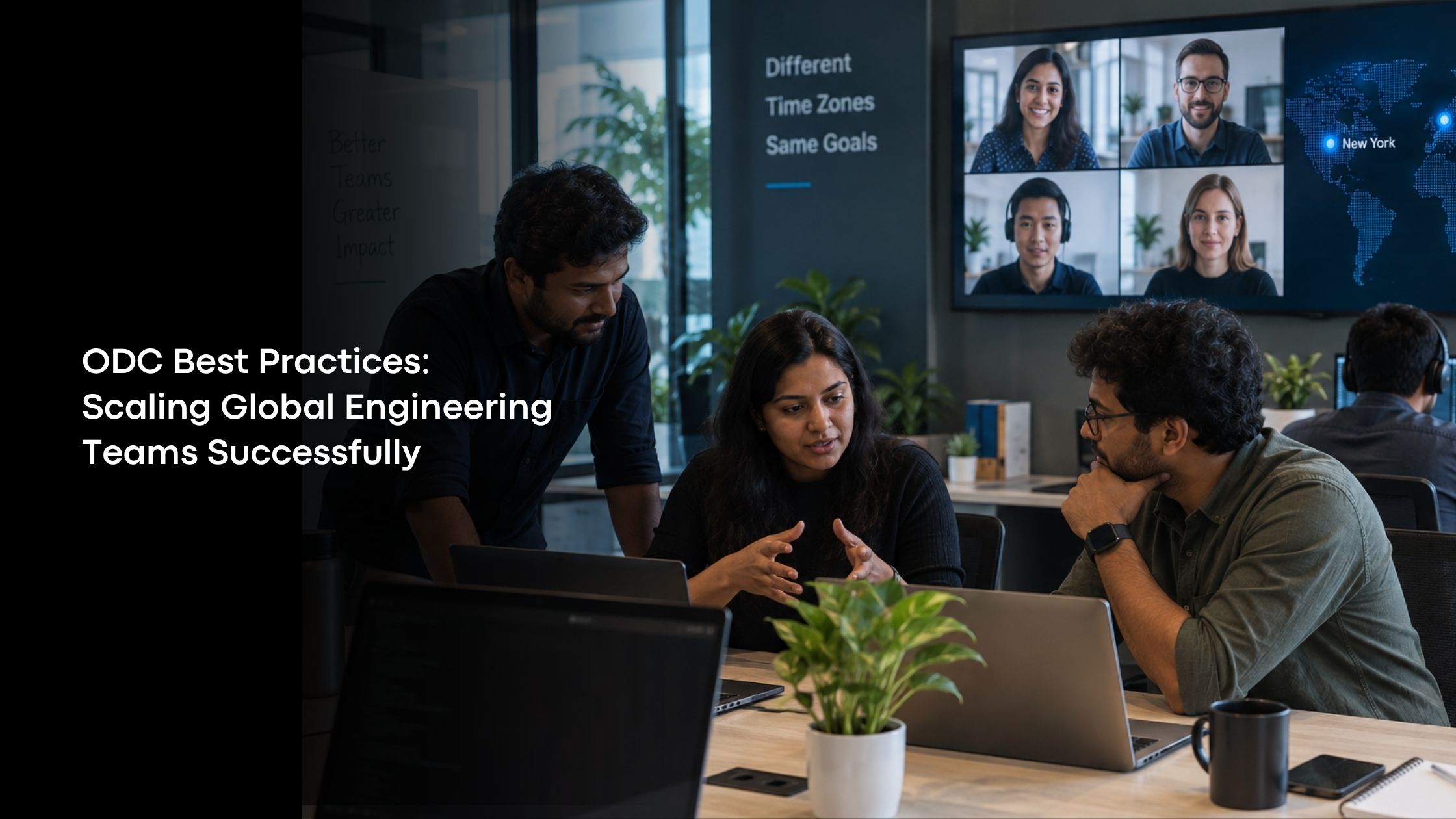
In 2026, Offshore Development Centers (ODCs) will no longer be considered a mere cost-saving measure but as one of the principal avenues for engineering leaders to grow through international expansion.
Those that are successful are getting more done through less spending. Their secret is creating cohesive, effective teams that uphold quality and a strong culture while producing consistent results, accepting accountability, and continuing to improve. Read on to learn some of the best Offshore Development Center (ODC) best practices for global expansion.
What Is an ODC in 2026?
An offshore development center (ODC) is a permanently located, fully committed engineering team that operates under the same standards as the parent company in a less expensive nation. It is sometimes referred to as “nearshore” if it is located on the same continent or region.
Understand that most outsourcing arrangements are project- or contract-based; an Offshore Development Center (ODC) gives you a team of engineers, designers, and managers that is working only for you exclusively, possibly for several years, not just one development sprint. A successful offshore development center should be based mostly on three key elements:
- Qualified human resources (people) that match your needs
- Proper office space and computer equipment (infrastructure)
- A development approach that will allow integration (process).
Usually, most ODC contracts start with just 3-6 core team members for the Dedicated Development Team and a team lead, and will expand when your product scales.
Why ODCs Scale Better Now
Owning the Delivery Centers allows high-growth companies to hire more without delivering slower, keep the pace up as complexity grows, and spot quality issues early, not after having made big investments. There are mainly three reasons why Offshore Software Development is still the main way of scaling a company:
Access to Deep Talent Pools
Large pools of competent developers, AI engineers, and cloud architects are made available by ODCs. As a result, there will be quicker team growth than with IT Outsourcing, which may consume time as well.
Near-continuous engineering progress
Distributed teams speed up release cycles by enabling 24-hour development, testing, and problem-solving. A remote development team is another helpful factor, but make sure to expand the team to a global level.
Building Long-term Capabilities
Understand that an Offshore Development Center (ODC) develops into integrated engineering units that gradually acquire institutional knowledge and domain expertise, in contrast to transactional outsourcing.
Best Practices for Scaling Global Engineering Teams
Here are some of the best practices for scaling Global Engineering Teams.
Define Scope and KPIs Before Choosing Location
Are you offloading your maintenance tasks or creating new microservices, or both? Becoming clear on these points will shape your requirement for personnel and your operations model next.
Consider factors like the level of English proficiency, availability of legal advisors in areas where intellectual property is concerned, the degree of a country’s political stability, and the frequency of flights from a selected city where the headquarters is located when choosing a country.
Pick the Right Operating Model
Captive (full control, higher initial setup effort) vs BOT (quick deployment today with the chance to own the assets tomorrow), or partner-led (vendor managed for more agility). In case of extended product development and operations control, you may find that a dedicated ODC is the best investment for you.
Stand Up Secure Infrastructure First, People Second
Thus, before the first engineer logs in, VPN gateways, endpoint management, and a replicated CI/CD pipeline should be operational. Before beginning work, confirm in writing who owns the IP and code. Before any engineer touches your repository, they should all be under an NDA and IP-assignment agreement.
Hire a Local Culture Champion Early
The presence of a highly-regarded engineering lead who is familiar with your agile rituals and respects local communication norms helps eliminate 90% of all friction. When the size of your offshore development team reaches 10-15 engineers at a single site, it’s time to appoint an offshore engineering manager.
Consider encouraging and providing opportunities to your senior offshore engineers so that they ascend the ranks to positions of tech lead and engineering manager roles within 12-18 months. This will not only build trust with your team, but also help clear bottlenecks.
Standardize Engineering Processes Early
To increase efficiency and ensure consistent results, standardize code review procedures, continuous integration (CI) and continuous delivery (CD) pipelines, documentation standards, as well as communication protocols. Set clear rules about PRs such as
- Every PR needs a minimum of two reviews by reviewers, of whom one has to be an expert
- PR review turnaround time is twenty-four hours
- All merge requests must respond to every review comment
- Major architectural decisions have to be documented and reviewed first (through asynchronous ADR).
Optimize for Time Zones and Async-First Work
To minimize collaboration friction, keep teams with dependencies in similar time zones. For round-the-clock coverage, use “follow-the-sun” SRE rotations and incorporate offshore teams with equal pay into on-call matrices. Protect deep work time by defaulting to async-first communication, which reduces meetings by 40–60% and increases productivity. Establish clear guidelines for asynchronous communication, such as
- Slack response SLA by channel type (urgent: 2 hours; general: 8 hours; non-urgent: 24 hours)
- Status indicators during working hours
- How to escalate a blocker asynchronously
- When it’s appropriate to call someone instead of using async.
The minimal feasible cadence for team cohesion is one synchronous touchpoint per week for the entire engineering team.
Make Writing the Default Communication Path
If you are working globally and are mostly doing remote work, you should always have writing as your main channel of communication. Product requirements, architecture decisions, and async updates should be done through shared documents so that all formal communication gets centralized and documented.
This way, there is no ambiguity left; you make the onboarding process for your team members way easier. Also, you will have a database of searchable documentation handy, which could be useful later.
Treat the Offshore Team as Core, Not Peripheral
A “One Team” mentality is necessary for the efficient administration of an ODC. Attend strategy meetings with offshore engineers, recognize their achievements, and support their career development. Set aside $1,000 USD per offshore engineer each year for
- Training
- Certifications
- Conference admission.
To maintain motivation, encourage engineers to obtain certifications, conduct internal training, and establish clear career progression pathways.
The Bottom Line
Are you ready to apply the OCD best practices to Grow Your Engineering Team? At Sira Consulting, we help businesses enhance offshore development centers that produce phenomenal results. We help you walk through each step so that you reach your target without any concerns.