
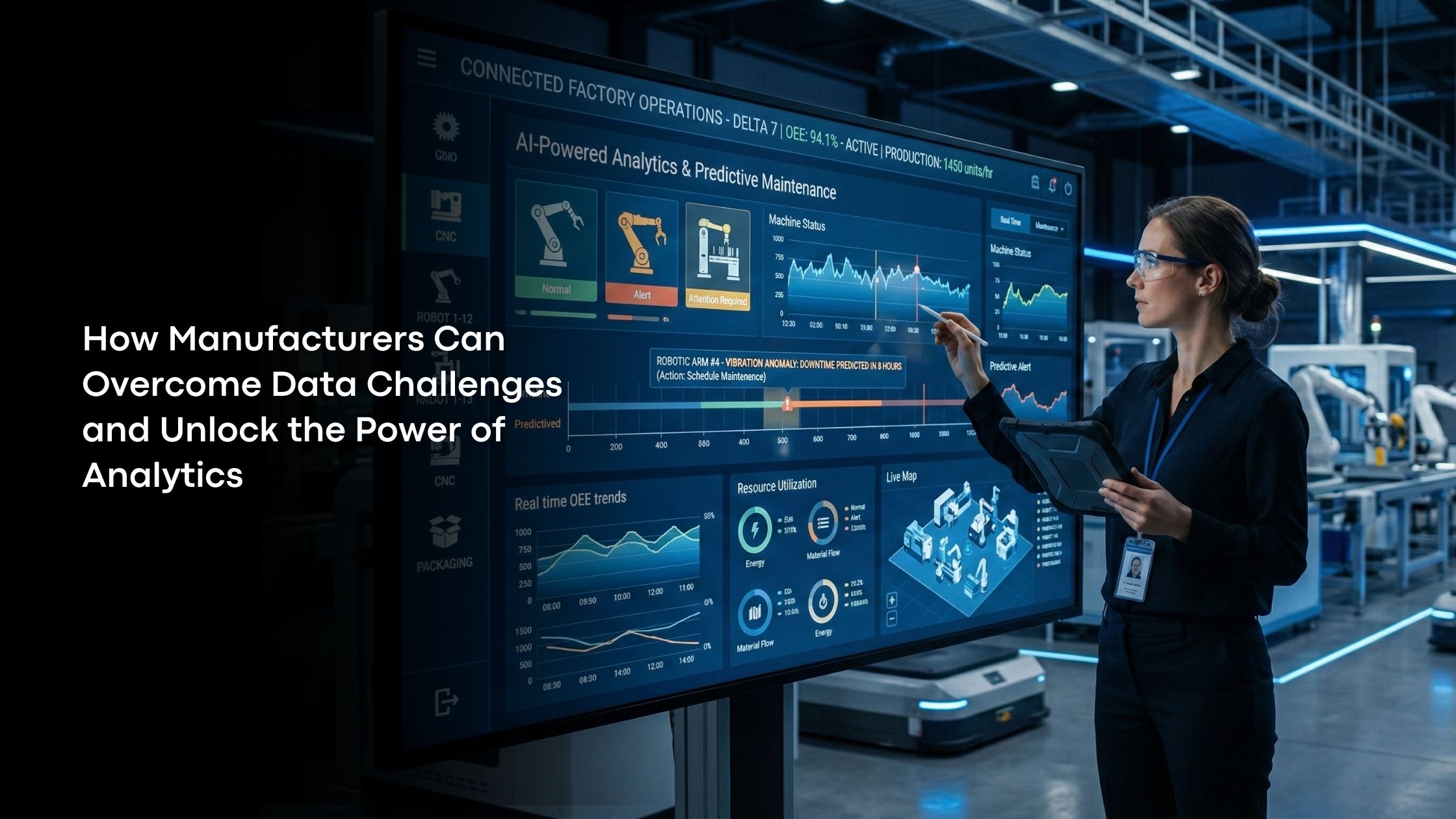
The economy today is digitally driven, and the competition is rising every minute. As a result, manufacturers are understanding that data is one of the essential factors for their operations.
With the ongoing Industry 4.0 movement and advanced analytics tools, there are strong possibilities to greatly improve efficiency. Manufacturers can now reduce costs, optimize quality, and drive innovation.
Most companies deal with huge amounts of data, but many cannot easily convert the raw data into useful insights. These data challenges are keeping manufacturers far from success and from understanding the true value of data analytics in manufacturing.
To address this, this blog explains key data challenges that manufacturers face, why analytics is important, and practical strategies to overcome bottlenecks and unlock data-driven growth.
Why Data Analytics Matters in Manufacturing
Before looking at the challenges and their solutions, you should understand how analytics is shaping the new manufacturing industries:
Improved Operational Efficiency
Manufacturers can find obstacles using analytics, oversee machine performance, and improve their workflows. It helps to have real-time visibility to procedures, and this lets teams work with waste and increase throughput, which is the basis for lean manufacturing.
Predictive Maintenance
Predictive maintenance is one useful benefit of analytics. With sensor data analysis, manufacturers can expect equipment failures before they happen. This greatly reduces unplanned downtime and repair costs.
Better Quality Control
With strong analytics, companies can enjoy real-time defect detection and analysis of root cause. This transforms product quality and helps avoid rework and scrap accumulation.
Supply Chain Optimization
With analytics, strengthening forecasting will become doable. It also helps with inventory management and supplier performance tracking. End-to-end visibility across the supply chain is also a benefit.
Sustainability and Compliance
Monitoring energy usage and emissions is important. Waste tracking as a manufacturer is also essential. Monitoring all these is possible with analytics. Data analytics in manufacturing will support meeting the goals of sustainability and regulatory rules.
Even though there exist different benefits, units at times fail to use analytics properly due to some common data challenges.
Top Data Challenges in Manufacturing
Data Silos and Fragmentation
A lot of manufacturers deal with data that is scattered across various systems. They can be ERP, MES, SCADA, CRM, legacy databases, and more. The data can lack integration among the systems. These data silos cause difficulty in creating a unified view of operations or performing cross-functional analysis.
Poor Data Quality
High-quality data is essential for analytics. But manufacturing companies use data that has missing values, inconsistent formats, wrongly calibrated sensor inputs, duplicate records, and more. All of these degrade insight accuracy.
Legacy Technology
Some manufacturing plants still run with old systems that have no interface features to work with modern analytics tools. Trying to extract valuable data from these systems will take lots of time, and the task will be incomplete.
Skills Gap
Data engineer groups, teams of data scientists, and analytics experts are essential for your analytics procedures. Note that these experts are difficult to hire and retain. Lots of manufacturers do not have local experts to deal with complex analytics projects.
Integration Complexity
It is hard to connect various data sources. You also need to normalize formats and perform analytics integration. If there are no standardized or unified data streams, analytics tools cannot be operated properly.
High Implementation Costs
Advanced analytics initiatives will require strong investment. Some examples are infrastructure, software, training, and change management. If you are a small manufacturer, you can find the costs for these features burdensome.
Strategies to Overcome Data Challenges
Below are effective strategies manufacturers can adopt:
Develop a Clear Data Strategy
Manufacturers will need to start creating a roadmap that explains what data to collect, how to manage it efficiently, analytics goals, and manufacturing KPIs for success measurement.
A solid strategy aligns analytics activities clearly with business objectives. It also prioritizes high-impact use cases like predictive maintenance or optimization of quality.
Break Down Data Silos
If you want to overcome silos as a company, enterprise data integration is essential. With modern data platforms, you can effectively break down data silos. It helps with system unification and data access across various departments in your company. Setting up data warehouses helps. Achieving real-time integration can be done with the help of APIs and connector implementations.
Improve Data Quality
Working on robust data governance and quality frameworks is essential. This step helps include standardized data formats and automated cleansing with validation processes.
It also helps with regular audits along with ongoing monitoring. Without trustworthy data, even the very strong analytics models can direct teams towards flawed decisions and misguided initiatives.
Modernize Legacy Systems
Instead of manually extracting data from dysfunctional platforms, manufacturers can benefit from a phased modernization strategy that deals with critical systems to cloud or hybrid environments.
The same strategy that also uses middleware for better interoperability and employs digital thread architectures to link lifecycle data from design through production is also important.
Foster a Data-Driven Culture
To embed analytics into daily operations and decision-making, leaders must cultivate a data-driven culture.
This can be done by educating teams on data literacy and its practical benefits. That will deliver real-time manufacturing insights through intuitive dashboards and visualizations. It will also help align analytics goals with measurable operational outcomes.
Leverage Cloud and IoT Technologies
Cloud solutions and manufacturing cloud analytics help create scalable storage, valuable processing power, and easy system integration.
This kind of integration will surpass weaker on-premises systems. IoT sensors can connect machines and produce real-time data streams that help work on advanced analytics, such as predictive maintenance.
Prioritize Cybersecurity and Governance
With data circulating quickly across systems and cloud platforms, powerful cybersecurity becomes unavoidable. It helps with data governance, encryption, secure access controls, regular security assessments, and compliance frameworks for data privacy.
Final Thoughts
When manufacturers overcome data challenges, they are not only improving operations, they are improving their business. The future of the manufacturing industry is data-driven, and the time to act is now.
If you are ready to transform your manufacturing data challenges into a competitive edge, seek the support of Sira Consulting. Their personalized roadmap aligns data analytics in manufacturing with your business goals, enabling smarter decisions and measurable growth.
Partner with experts from Sira Consulting to integrate cloud, IoT, and advanced analytics for real-time insights and predictive power.
Schedule a consultation with Sira Consulting to find out how their proven frameworks in data governance, talent building, and cybersecurity can unlock actionable intelligence for your operations.