
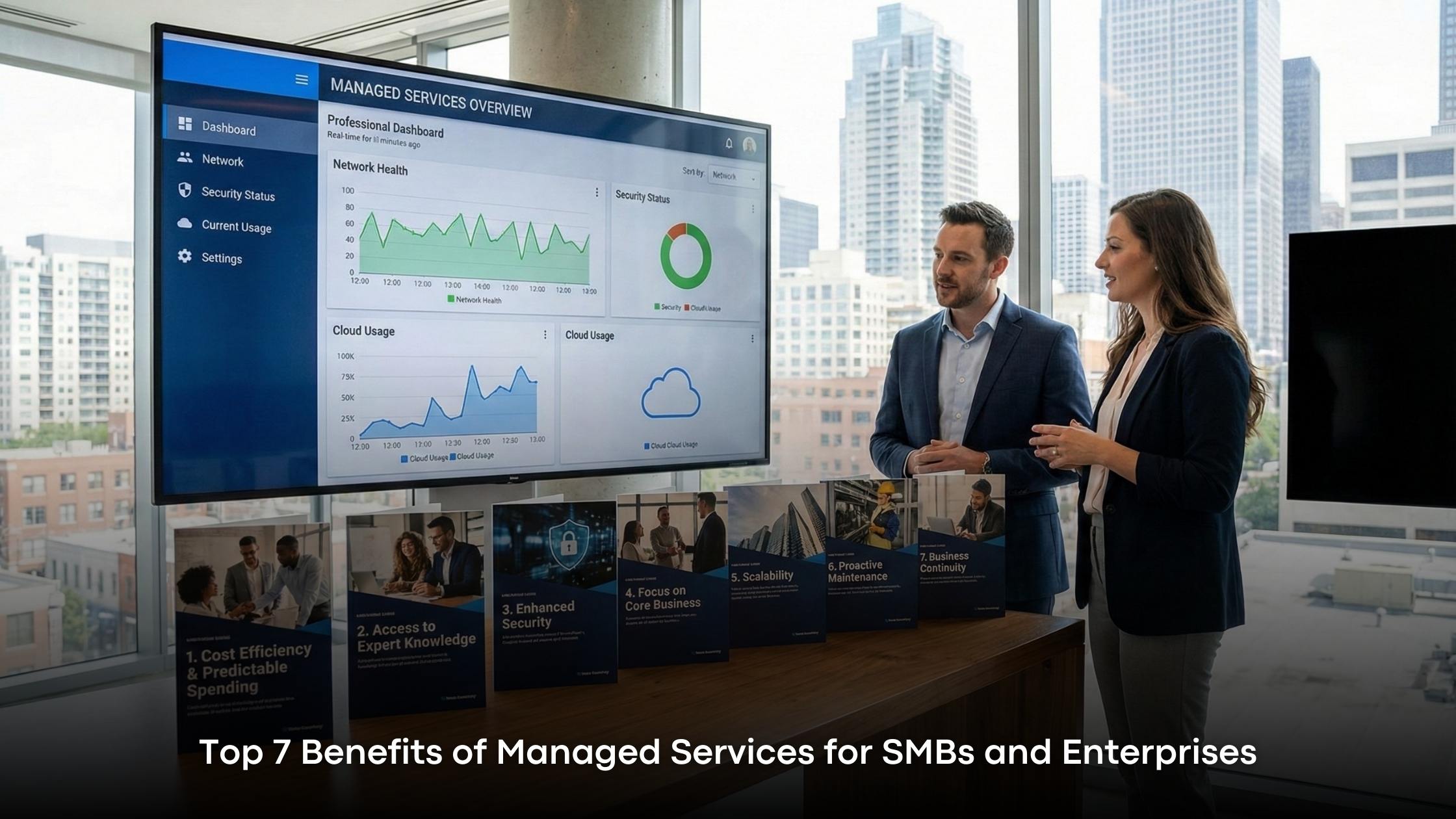
Managed services have become a strategic advantage for both SMBs and large enterprises navigating today’s digital business environment. Organisations can outsource their IT needs to expert providers who will deliver precise management of their infrastructure, security, and support requirements, rather than handling them in-house.
Managed services help businesses achieve operational efficiency, cost savings and reduced downtime because they enable companies to concentrate on their growth through secure and scalable technology that is ready for future developments. Let us dive into the blog to know the top 7 benefits of managed service for SMBs and enterprises.
1. Cost Efficiency and Predictable IT Spending
Cost management is one of the major benefits of managed service. The service model requires businesses to make monthly payments rather than invest in expensive hardware and software.
The subscription system stops unplanned maintenance expenses through its predictable system which helps businesses decrease their equipment purchasing needs. By adopting cost saving IT services, organizations gain better financial control while avoiding sudden capital expenditures.
The subscription system allows small and medium-sized businesses to access enterprise-grade IT support while large organisations achieve budget efficiency and decrease their operational expenses.
2. Access to Expert Knowledge and Advanced Skills
The fast-paced evolution of technology creates challenges for organizations that need to stay up to date on modern tools and security measures. Managed service providers (MSPs) staff their operations with certified professionals who possess comprehensive expertise across various IT fields.
It covers cloud computing, cybersecurity and network optimization. The SMB sector benefits greatly from SMB IT managed services, gaining access to high-level expertise that most companies cannot afford, while large organizations strengthen internal capabilities with specialized support
This system enables continuous access to modern technological solutions for business which stay up-to-date with industry best practices without needing ongoing educational programs.
3. Enhanced Security
All businesses need to pay attention to cybersecurity because cyber threats have become a common danger. The major advantage of managed IT services enables organizations to conduct continuous surveillance of their technological systems which lets them identify potential security risks.
Managed service providers deliver continuous monitoring, active threat detection, and immediate incident response capabilities to protect vital information and systems. The managed services provide protection against security threats that might disrupt business operations through their network security services and compliance management solutions.
Companies achieve enterprise managed solutions through the implementation of enterprise managed solutions which help them decrease operational risks while continuing to develop their businesses.
4. Improved Focus on Core Business Objectives
IT infrastructure management activities lead organizations to divert resources from their core strategic objectives. The management of intricate IT systems creates challenges for both SMBs and large companies because it consumes their essential business resources. Managed services provide organizations with their fundamental operational benefit.
Organizations that outsource their IT management, monitoring and support services to professional providers will experience decreased operational demands and fewer security threats. Managed services enable leadership teams to concentrate on business expansion, improving customer satisfaction and establishing market advantage without being distracted by technical issues that happen every day.
The organization achieves dual benefits from proactive system management which establishes fixed expense structures and provides access to specialized knowledge. It helps organizations meet their strategic objectives while maintaining operational excellence.
5. Scalability
Scalability is the main reason why managed services are becoming popular among small and medium-sized businesses and large enterprises. Businesses need to develop their capacity to handle business growth, changes and temporary business interruptions because of the ongoing digital transformation in the current business environment.
Managed services provide organizations with flexible IT resources that evolve to meet their business needs, eliminating the need for substantial initial investments in both infrastructure and human resources. Managed service providers maintain system performance by delivering agile and secure solutions.
The system’s scalability enables organizations to focus on developing new solutions and achieving their primary business goals. Their IT systems support expansion needs through smooth and dependable development processes.
6. Proactive Maintenance and Reduced Downtime
The businesses require comprehensive IT functionality to avoid unexpected outages that disrupt operations. Managed services provide SMBs and enterprises with a proactive monitoring solution that prevents operational disruptions by proactively managing IT systems.
Managed service providers use their continuous monitoring system together with regular software updates and scheduled maintenance activities to discover upcoming threats and eliminate them. The organization implemented regular system maintenance procedures which successfully decrease both security risk and unscheduled operational interruptions.
The organization achieves greater system performance and efficient operations which results in increased staff efficiency. Managed services help businesses maintain business growth and customer satisfaction while they protect their essential systems through active system monitoring.
7. Business Continuity and Disaster Recovery Support
Unexpected events that include cyberattacks, natural disasters and hardware failures can cause operational systems to experience major interruptions. Both small and medium-sized businesses and large enterprises depend on managed services to maintain their operational activities through business interruption and their operational activities through business interruptions and their capabilities to recover from disasters.
Organisations require proactive IT support that exceeds basic troubleshooting, as cyberattacks, system failures, and natural disasters have become everyday occurrences. Managed service providers (MSPs) deliver structured backup solutions together with quick recovery methods and ongoing system oversight.
It shows how managed services help organisations build stronger defence systems that protect their data and let them resume operations while keeping their business running and expanding over time.
Bottom Line
Hope you now have a clear idea of the benefits of managed services. Managed services enable SMBs and enterprises to achieve better operational intelligence, increased speed and enhanced security while decreasing their operational expenses and simplifying their IT operations. The organization gains direct productivity benefits which lead to business expansion through its proactive monitoring, improved cybersecurity, its expandable solutions and specialist assistance.
Sira Consulting provides a way to access these benefits which prevents customers from needing to control all operations themselves. The company provides customized managed services that deliver reliable service, efficient system operation, and customer peace of mind. Sira Consulting offers businesses the opportunity to build a future-ready IT ecosystem through its services. Get started today!