
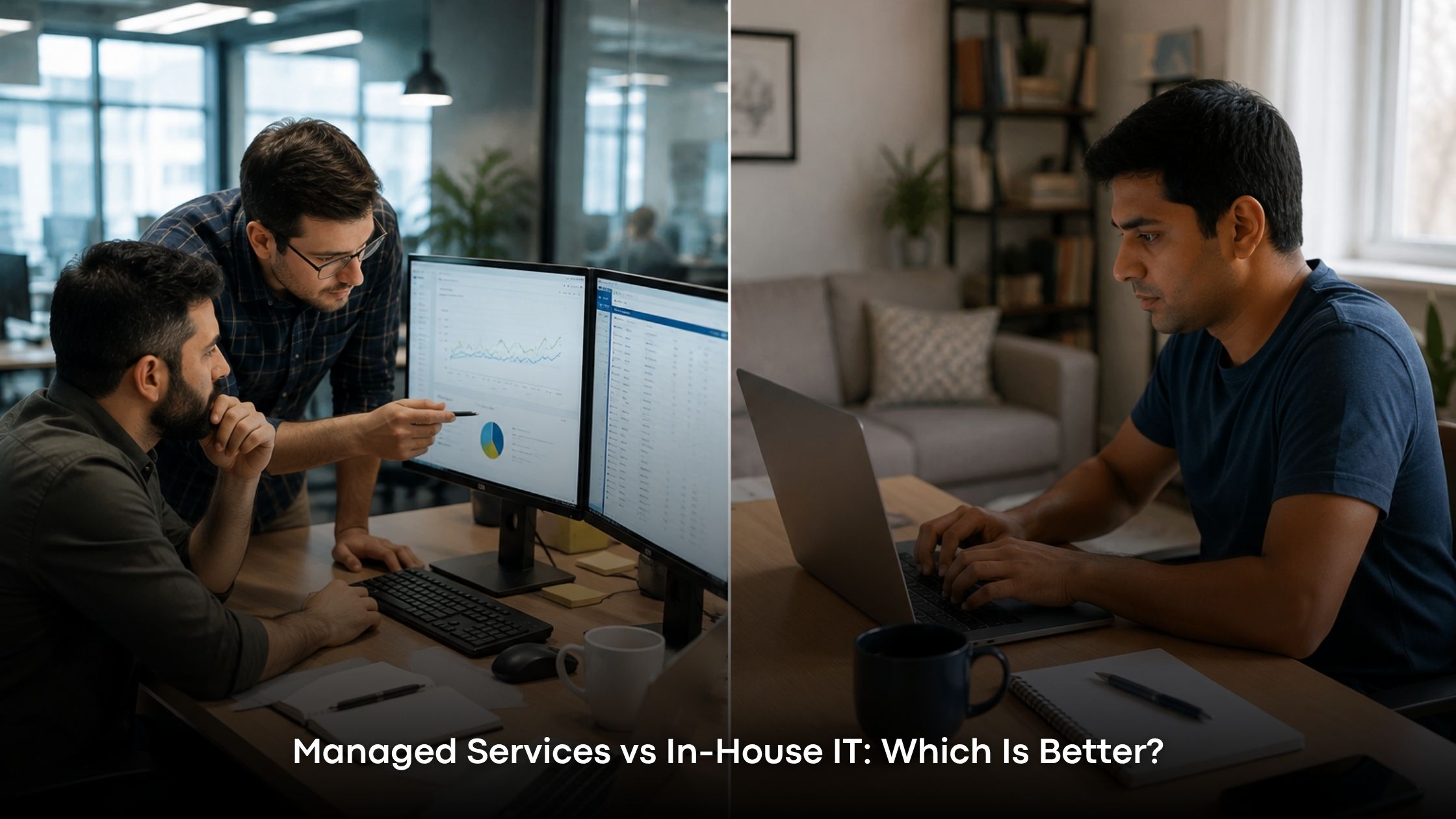
Selecting between a managed service provider and a company-owned IT team is one of the strategic technology decisions a business can make.
Your decision on this matter will largely be influenced by such factors as the size of the company, the budget, the industry rules which the business has to comply with and the plan for the future growth.
On one hand, internal IT teams are known to work closer to the business needs and give a higher level of decision-making power. On the other hand, Managed IT Services offer more flexibility and can help businesses with their staffing requirements, which is always an expensive and time-consuming part. Read to learn more about the two options.
Understanding the Two Models
In-house IT
In an in-house IT department, the responsibility to construct, run, and keep the internal technology team lies with your company only. Not only are you responsible for hiring the staff, but also for providing them training.
It also involves buying hardware and software, and being the go-to person for everything starting from helpdesk tickets right up to cybersecurity. This setup lets you make choices on your own as far as which issues should be handled first, how quickly you react, and also gives you full insights of every business process.
Managed IT services
In contrast, Managed IT Services refers to the practice of outsourcing your IT operations to a third-party (a provider like an MSP in most cases). With such a contract, they offer services like monitoring networks, managing cloud resources, providing security, and user support on a subscription or contract basis through a Service Level Agreement.
What Suits Your Business The Most?
If a business wants to choose between in-house and outsourced IT services, several elements like company size, budget, and specific IT requirements will influence the decision. Sometimes the requirement from your business is for various IT services, a constrained budget, or the lack of human and material resources needed to set up an in-house IT team. In these situations, outsourcing the IT services to a Managed Services Provider could be the best solution.
Conversely, if your company needs highly specialized or customized IT support, has the recruitment capability of an internal IT team, and prefers not to outsource all the IT functions, then an in-house IT staff setup might be preferable.
Of course, you do not necessarily have to choose between these two types of services either. A great idea is to blend both services by going for a hybrid solution where the company has their in-house IT team together with a managed services provider that will complement them. The way to do the same would also enable you to cover the deficiencies of your current inner team by having their help and achieve faster growth through their added value.
Can managed IT services still be advantageous to a company that uses in-house IT?
Yes, a company with an in-house IT team can still opt for outsourced Managed IT Services. If the in-house team lacks knowledge and experience of certain areas, managed services can bring in specialized assistance which they don’t have such as cloud services and high-end security measures that would enhance the capabilities of the existing IT staff.
IT Outsourcing can remove repetitive and administrative duties, so the employees in the IT department will be able to work on complex and important projects.
Companies taking the hybrid path by combining direct control and using an external service for some operations can have an unfair advantage through the combined strength and resources of the MSP and their internal operations.
Comparative Evaluation of Managed and In-House Services
Flexibility in Budget and Cost:
Salary, infrastructure, training, and long-term equipment costs are all fixed costs associated with running IT internally. In contrast, the pay-as-you-go model from managed IT Support Services firms makes budgeting more flexible and predictable.
This cost structure is frequently simpler to manage for startups and SMBs. For mission-critical tasks, larger businesses might still favor internal teams; however, for specialized or scalable tasks, they might combine them with MSPs.
Knowledge and Skills Available:
Many internal teams are unable to keep up with the rapid advancement of technology. Cloud, cybersecurity, AI, and DevOps specialists skills that are costly and challenging to develop internally are employed by MSPs.
This gives managed services a significant advantage, particularly for businesses that wish to have access to cutting-edge resources and skilled personnel without making significant financial commitments.
Agility and Scalability
In-house development is very slow when it comes to scaling since first you need to add new members to your team, provide them with training and give everyone enough time to get used to the new way of working.
Then again, Managed Service Providers can scale instantly, so they are a perfect choice for businesses whose workload fluctuates or which plan for rapid growth or whose business is seasonal. Being able to help both small and large-scale operations makes outsourcing IT a great advantage in highly volatile markets.
Security And Compliance
MSPs spend their money on security measures like high-grade threat detection, Zero Trust models, protection against endpoint attacks, and constant (24/7) threat monitoring with specialized tools.
For example, Apart from this, they are always aligned with the regulatory structure by keeping themselves certified, SOC 2, ISO 27001, and GDPR through their data compliance policies. Although one’s internal staff offers a certain degree of policy flexibility and control, trying to match the level of security maturity of an MSP is expensive and technically demanding.
Technology and Innovation Adoption
As they operate across platforms and industries, MSPs are quicker to adopt new technologies, such as cloud automation, AIOps, digital workplace tools, and sophisticated monitoring systems. The longer training and approval cycles that internal teams might need could hinder innovation.
Business Focus and Productivity
IT departments can sometimes get bogged down with the regular IT issues that come their way and as a result, do not get enough time for strategic projects.
Outsourcing operational tasks would free leaders and managers of the business and IT Infrastructure Management to spend their effort for innovative ideas. This transforms their businesses with the help of digital technologies. Carrying out customer-centric plans with IT Infrastructure Management rather than being constantly on their toes due to a lack of problem resolution skills helps.
The Bottom Line
Choosing Business IT Solutions needs more than just comparing the pros and cons of having managed services versus hiring an in-house team. It’s helping understand how these choices align with your broader business goals.
At Sira Consulting, we have a team ready to guide companies making such tough decisions. The process starts by evaluating a wide variety of factors including existing assets, the amount of money you want to spend, and the way the organization wants to expand. Finally, if the decision is for hiring full-time employees, going for a Managed Service Provider like Sira Consulting is what your company should do.