
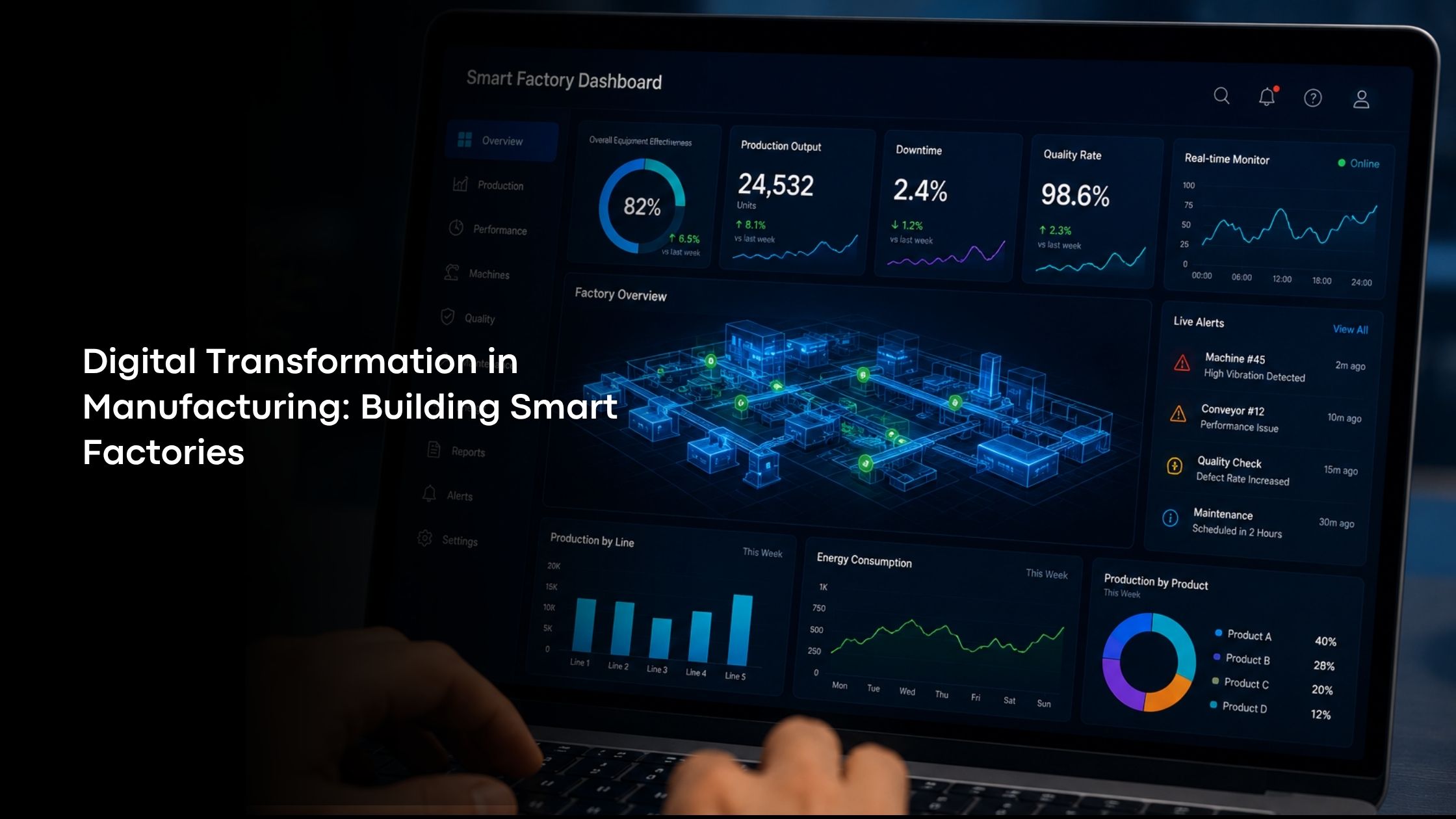
The manufacturing industry is going through the changes on quite a large scale. Manufacturing facilities are now being replaced by smart factories or fully automated factories. Understand that the term Digital Transformation in Manufacturing indicates the integration of new technologies like software, robots, and data analytics. It helps increase manufacturing efficiency, cut costs, and satisfy customers faster. This blog is a good read if you want to know everything there is about digital transformation in manufacturing and see some related examples.
What Is a Smart Factory?
A smart factory is a manufacturing system that improves production using information and communication technologies (IoT), artificial intelligence (AI), robotics, and cloud computing. Smart Manufacturing is a fully integrated manufacturing system that uses sensors and sources of information to connect machines, people, production, and processes.
Unlike conventional factories where machines work alone, smart factories are zeroed-out. The elements communicate with each other, the line re-configures autonomously, and the manager supervises from any location through the PC or the phone.
Why Are Manufacturers Going Digital?
Manufacturers are now looking forward to using smart factory technologies due to a number of factors:
Growing Client Expectations
Consumers want better quality, personalized goods, and quicker delivery.
Disruptions to Supply Chains
Global supply chains witnessed their vulnerability during pandemic. With smart factories, the industry is now dealing with changes more smoothly.
Shortages of Workers
It is not easy to find workers who can handle modern-day factories. But with AI, it is manageable.
Cost Pressure
Businesses must cut waste, energy consumption, and downtime to remain profitable in the fiercely competitive market.
Goals for Sustainability
Customers and governments are demanding greener manufacturing. Smart factories use data to lower energy use and carbon emissions.
Key Technologies Powering Smart Factories
Internet of Things (IoT)
IoT sensors can be connected with machines, tools, and even products for monitoring purposes like temperature levels, vibration levels, speed, and other such parameters. Data can be sent to a central system for analysis after it has been gathered from these sensors.
For instance, if the central system is able to identify a machine heating up abnormally, Industrial IoT can send alerts to the maintenance team so that they can take preventive measures before the machine actually breaks down.
Artificial Intelligence (AI) and Machine Learning
AI studies the data that IoT sensors have gathered to identify patterns and predict what might happen next. AI in Manufacturing can warn about equipment failure, optimize production schedules by planning, and even upgrade the quality of products by continuously fine-tuning the settings automatically.
Robotics and Automation
Robots are used for tasks where repetition is required, a risk to human lives, or a precision that humans may not guarantee, such as welding or metal fabrication, spray painting, and assembly. Nowadays, robots collaborate with humans and can be easily reprogrammed for new production cycles.
This kind of versatility is exactly what allows factories to produce so many diverse products. Industrial robots can also be used to perform simple but dangerous tasks like carrying heavy loads, painting with chemicals, etc.
Cloud Computing
Cloud platforms save and handle the large amount of data produced by smart factories. Besides, they enable different departments to access the production data even if they are not physically present on-site. So teamwork and managing multiple factories is made very simple.
Digital Twins
Digital twins are created by combining digital data from different systems and processes to simulate a physical factory environment.
Engineers can use the digital twin to simulate different scenarios to see how they would affect the actual factory operations without having to actually carry out the changes in the physical factory.
5G Connectivity
For thousands of devices in a factory, 5G networks offer dependable, fast connections. Real-time communication between robots, machines, and control systems depends on this.
These are some of the advancements that are products of Industry 4.0 for breakthroughs in the industry.
Benefits of Smart Factories
Manufacturers that integrate smart factory technologies into their operations observe significant results. You will get to know how Digital Transformation in Manufacturing benefits the industry briefly here.
Production processes get faster without increasing error rates, and as a result, overall productivity increases by about 30 %.
An application of AI for predictive maintenance greatly decreases unplanned equipment failure times, and maintenance costs are also halved. Real-time quality monitoring helps detect and correct defects very early in the process, which is great for customer satisfaction.
Flexible automation makes it possible to switch between different products or versions very quickly, so time to market new products is a lot reduced. Energy consumption drops as smart systems optimize usage, helping manufacturers meet their sustainability objectives. Workers’ safety is improved, since robots can take over dangerous tasks. This is how workers’ injuries at the workplace have been reduced.
Real-World Success Stories
Around the globe, the biggest producers are enjoying smart factory perks already. Siemens is one of the companies optimizing the production process by reducing setup time and improving quality on an ongoing basis through the use of digital twins and AI in its electronics plants.
Another example is Murata, one of Japan’s largest electronic production companies, using IoT and AI for tracking production lines simultaneously and making necessary changes quickly to enhance efficiency.
Deloitte’s report says that companies implementing smart factories can raise productivity by as much as 30%, and maintenance costs can be lowered by 20%. These success stories clearly indicate that the digital transformation is a win-win strategy when it is a well-executed one.
The Future of Smart Manufacturing
The Digital Transformation in Manufacturing is definitely going to make things smarter than ever. Fully self-operating production lines capable of self-optimization without human involvement will bring the industry to levels of efficiency never seen before.
Super personalized production will provide factories with the potential to produce as per demand. Smart energy management powered by AI will lead to zero-waste production and carbon neutrality.
The manufacturers that go through digital change now will lead the future of the industry and overtake the competitors that are using the old ways. It will take time to adapt to the change, but the returns will be worth it, as it promises sustainable business growth and a market leader position.
The Final Words
Are you looking for Manufacturing Automation? At SiRa Consulting, we accompany manufacturers in implementing smart factories through expert strategy, careful technology selection, and smooth change management. Get in touch with us to create a production plant that is future-ready.