
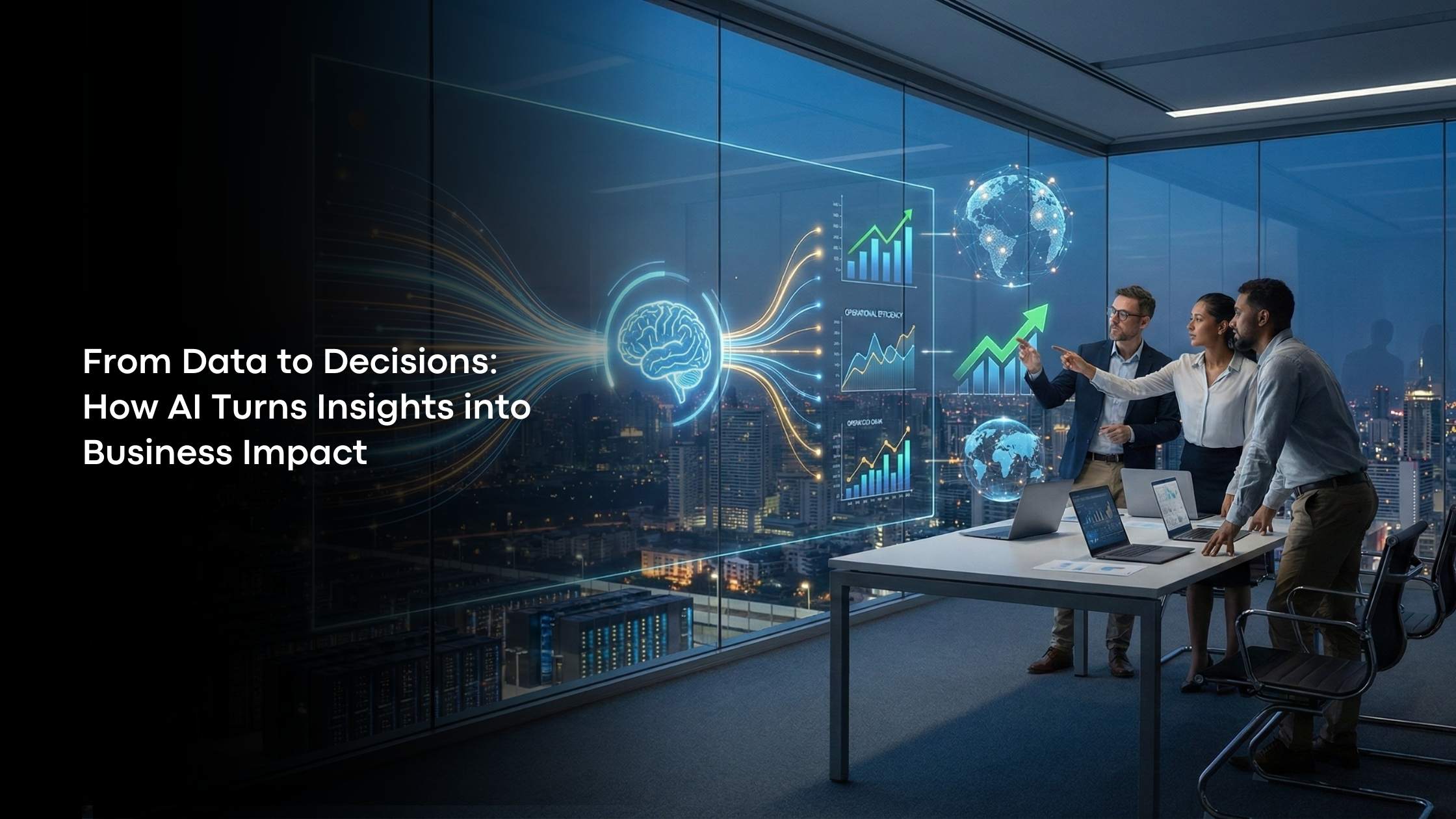
The data-driven world requires more than just information because organisations must demonstrate their ability to utilize that information in a smart way. The process of Artificial Intelligence operates as a link that connects unprocessed information with business strategies by discovering patterns.
It enables organizations to make better decisions faster, especially when supported by AI and data analytics in business. AI technology processes intricate data to generate simple understandable insights which businesses use for two purposes: operational efficiency improvements and customer experience development.
The process of moving from data analysis to decision-making creates new business methods for innovation development and competitive advantage establishment while measuring their actual market effects. This blog explores how AI turns insights into business impact.
The Evolution from Data Collection to Intelligent Insight
Companies used to concentrate their efforts on data acquisition and data preservation which they analysed through manual methods and basic reporting systems. The system provided historical performance data but it failed to enable organisations to make decisions based on future projections.
Modern enterprises now operate in real time, requiring insights that are immediate, contextual, and actionable. Through AI and data analytics in business, organisations can process both structured and unstructured data at scale while discovering hidden patterns and relationships across datasets.
Turning Complexity into Clarity
The main advantage of artificial intelligence systems lies in their ability to handle complex problems by providing simpler solutions. Market conditions, customer preferences and operational factors all experience constant change throughout each day.
Transparency in large datasets is important for data driven decision making, where decisions are informed by data rather than guesswork. Consequently, faster market response measures and strategic planning to meet business objectives also highlight bright spots in organisations’ risk management.
Enhancing Business Intelligence with AI
AI systems enhance business intelligence by learning to adapt to changing business requirements. Intelligent systems use data analysis to detect patterns and unusual occurrences which they then use to recommend appropriate actions.
Business intelligence functions as a predictive tool which uses current events to explain their significance while guiding organisations in their response to these events.
Predicting Outcomes Instead of Reacting to Them
The primary strength of AI systems becomes evident when they use their abilities to forecast future events. Organisations use predictive analytics to promote customer behaviour, demand fluctuations, equipment failures and financial risks.
Businesses can implement forward-looking resource management strategies which enable them to sustain their market advantage during times of rapid industry changes.
Improving Operational Efficiency Through Automation
The process of improving operational efficiency through automation requires implementing AI technologies that provide operational insights to guide decision-making and drive organisational initiatives. The intelligent systems take charge of work processes which include inventory restocking, fraud detection and customer support dispatching activity.
Organisations achieve operational efficiency and cost savings through automated system implementations which reduce their reliance on human labour and reduce the risk of computational errors.
Personalising Customer Experiences at Scale
Modern customers expect personalised interactions across every touchpoint. The system develops personalised recommendations, special offers and customer communication through its analysis of current customer data. The insights help businesses to understand customer preferences, promote customer needs, and deliver relevant experiences at all times.
The process creates greater customer engagement which leads to stronger customer loyalty and business relationships that develop deeper connections between businesses and their customers.
Driving Smarter Growth Decisions
The process of making growth decisions requires smarter driving methods for better results. Today, businesses must expand their operations through strategic growth, which requires them to select their target markets correctly.
AI-powered analytics for business growth showed businesses their most valuable customer groups which new markets they should target and which products they should discontinue. The organisation provides leaders with tools to determine which factors generate revenue and which elements increase profit margins by enabling them to make sustainable business growth investment choices.
Strengthening Risk Management and Compliance
The organisations use AI technology to achieve two primary objectives because it serves as their core operational component. The intelligent systems employ automatic analysis to handle extensive datasets which allows them to identify fraudulent activities and monitor compliance with regulations at a higher success rate than human operators.
Organisations implement early warning systems alongside real-time alerting systems to manage their challenges. Without compromising their financial stability and corporate reputation, this will ensure that they remain efficient in carrying out all their operations.
Embedding AI into Strategic Planning
The organisation requires AI technology to be a fundamental component of its decision-making framework to achieve sustainable success. AI in business strategy uses data insights to develop new products and choose entry strategies for markets while establishing pricing methods and determining market presence.
The organisation requires this alignment implementation because it allows data and intelligence to drive its upcoming development work which extends beyond normal operations.
Driving Competitive Advantage with Analytics for Business Growth
The advantages analytics deliver for business operations are competitive advantages for organisations. The AI-powered analytics for business growth provide organisational leaders with vital business expansion insights.
The AI system enables organisations to achieve sustainable growth by identifying profitable markets, optimising pricing strategies, and improving product performance. The AI analytics solutions businesses use enable them to achieve a competitive advantage through faster, higher-quality decision-making.
Real-Time Decision Making in Fast-Paced Markets
In fast-moving industries, timing controls all aspects of operations. AI systems provide businesses with the ability to conduct immediate data assessments which enable them to adapt to operational changes.
Organisations use real-time insights to make pricing adjustments, inventory controls and customer feedback responses because these insights help them make timely and relevant decisions that improve their competitive advantage.
Winding It Up
The process of converting data into useful business decisions has become essential because it drives successful business operations in modern enterprises. Through AI and Data Analytics in Business, organisations can uncover hidden patterns which help them predict upcoming events while making decisions that improve their ability to compete in their respective markets.
Sira Consulting provides organisations with services that transform their unprocessed data into usable intelligence which leads to measurable organisational outcomes. Sira Consulting offers businesses a support that enables them to make better decisions, improve their operational efficiency, and protect their future through AI-based business strategies.