
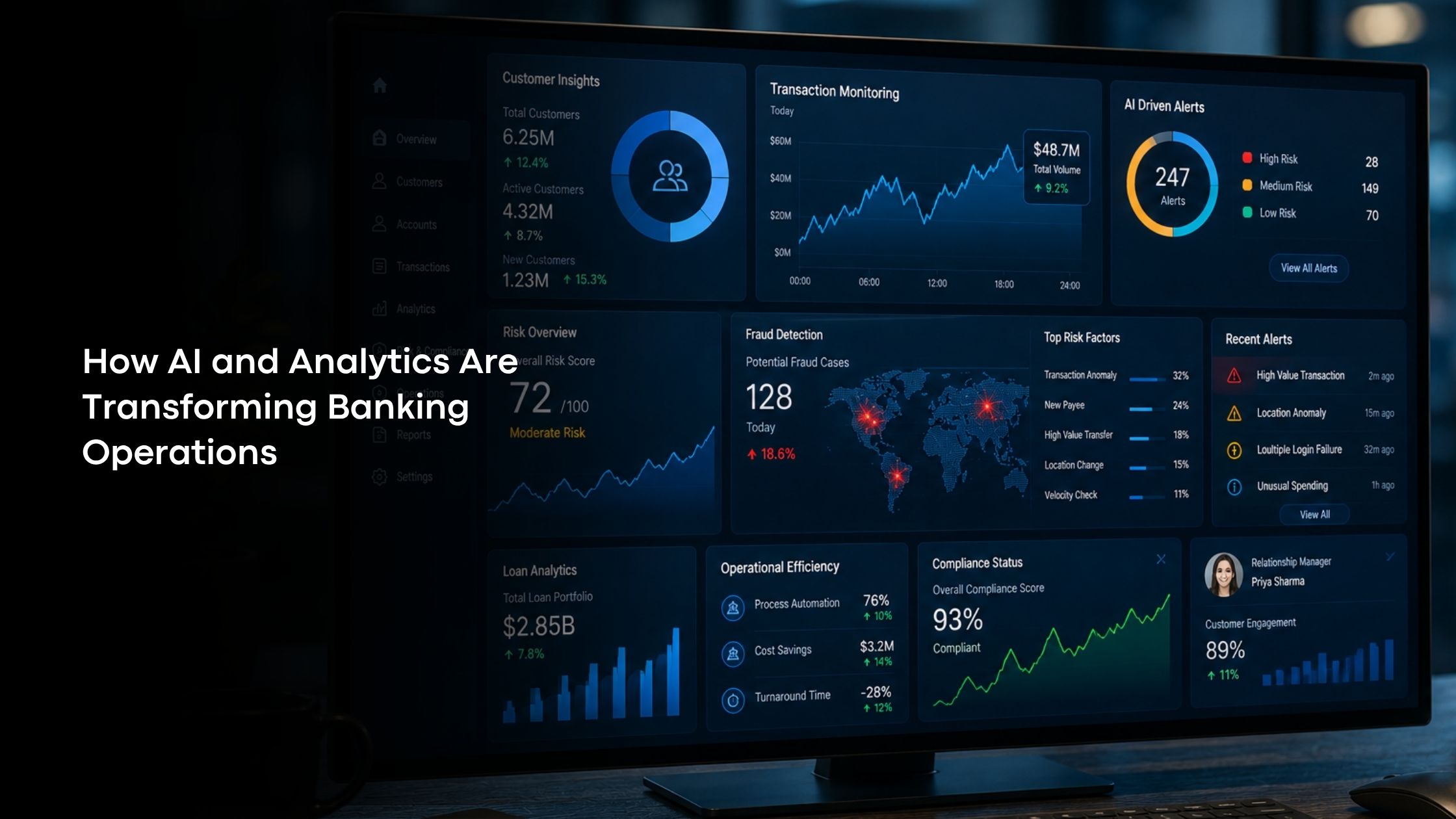
Artificial intelligence (AI) and advanced analytics are transforming the banking industry into smart and people centric. It is converting a business historically dominated by transactions using legacy systems into a new one that is driven largely by data. AI in Banking will help not only in getting quicker decisions and reduced costs but also in stronger legal compliance and improved satisfaction of their customers. Read on to understand how AI and Banking Analytics are transforming banking operations.
Why AI Matters in Banking Now
Banks process extensive customer transaction data, document data, and customer interaction data. Legacy systems have problems handling vast amounts of data at the speed and accuracy required.
By automating processes, detecting trends, and providing real-time data through AI and analytics, these issues at least partially disappear. As a result, Digital Banking can save on costs, better comply, and react faster to changes in the market.
AI Acts as a Proper Personal Assistant
With the help of AI as a sales assistant, a relationship manager will be able to assess lead and opportunity scores across various services and products, like bundle checking to secured loans. This way, AI in Banking will increase the relationship manager’s performance in predicting the potential of the business lines, whether it’s investment, commercial, or retail banking.
Predictive AI in one place can reveal valuable insights for either maintaining relationships or attracting new clients of the bank. By integrating both external parties and internal data sources, generative AI can offer job flow recommendations and increase the recommendation accuracy and relevance. Financial Data Analytics is now helpful in the financial aspect of banking institutions.
Armed with the powers of predictive and generative AI, a relationship manager will have a clear idea of the perfect channel to get in touch with the client. Offering them a relevant and attractive deal that is just for those client needs that the relationship manager has to address.
Core Areas of Transformation
Customer Experience and Engagement
Understand that Artificial Intelligence in Banking allows banks to be more relevant and consistent in their delivery through the following to make things easier and more tailored for customers.
- Apps
- Websites
- Live chat
Virtual assistants and chatbots can answer common questions instantly when used 24/7, while advanced analytics can provide offers and guidance that suit an individual’s needs.
Risk management, Credit, and Lending
AI-based credit models use a richer set of data, including cash flows and non-traditional indicators. This results in greater precision in expectations of risk of default and expedites the approval process for credit loans. As market conditions change, banks will be able to adapt credit policies in a more agile manner, reduce bad loans and grow responsibly.
Fraud Detection and Financial Crime Prevention
Artificial Intelligence systems analyze millions of transactions in real time, allowing them to prevent fraud losses by identifying anomalies. AI in Banking can also be used for Anti Money Laundering (AML) by discovering suspicious relationships between customers and risky behaviors. This also automatize one of the most labor intensive parts of investigation processes.
Operational Efficiency and Automation
AI simplifies routine back-office operations such as entering data, managing documents through their lifecycle, and performing reconciliations. Smart features allow AI to pull important details from IDs, bills, and forms with a high degree of accuracy. Not only does this reduce mistakes and save money, but it also enables employees to be engaged with more important work and serve customers better.
Data-driven Decision-making and Strategy
Advanced analytics allow decision-makers throughout the company to convert unprocessed data into easily digestible insights.
Through real-time dashboards and forecasting models, leaders make price and product as well as risk decisions quicker and with the evidence. That is why this leads to a setup where strategy, operational, and risk teams all base their work on the same reliable data.
What an AI-first Bank Looks Like
Using a combination of AI and a forward-thinking approach, such a bank relies on the best data platforms, modern APIs, and cloud solutions that are the backbone to deliver real-time insights. It offers custom-tailored experiences, handles the automation of crucial processes, and makes decisions with the help of AI a part of daily routine.
And, there is a shift in the operational model. Understand that it includes newly created roles, enhanced skill sets, and better governance that ensure a careful and responsible expansion of AI within the organisation.
Measurable Business Impact
AI is providing tangible benefits for banks that implement its offerings at scale. It is projected that the use of AI across a bank’s operations, risk, and customer service departments would save the world’s banks hundreds of billions of dollars.
Full introduction of AI across the full end-to-end process can lift efficiency ratios by as much as 15 percentage points. On the other hand, specific use cases in processes like document handling and onboarding can lift efficiency by up to 50 percent.
Real-World Use Cases in Banking
PenFed Credit Union will make use of Einstein, a virtual assistant, within their internal processes and later their outward-facing processes through generative AI. Einstein will recommend chat and email responses that service representatives can quickly adopt to short-circuit queues. The program will initially furnish responses to a chat or member inquiry from PenFed’s internal employee help line and later be directed to members. Also, it will suggest a response to any chat or member inquiry.
Ponce Bank applies Einstein AI for dynamic content and to communicate the right message at the right time. This enables Ponce Bank to offer smarter and more profound relationships with its customers, prospects and serve its variety of underbanked and underserved communities more effectively.
Integration of AI by banking teams: the Corporate and Commercial Banking team at Santander is making use of AI to expand their Santander Navigator platform. As a result, there is a huge surge in customers joining, visualizing current international trade flows and customer insights in real-time CRM Analytics, and producing tailored recommendations based on customer data. This innovative approach to AI will allow Santander to grow their platform and can become a sector standard, with plans to incorporate ideas such as ESG ratings and sustainability features.
The Bottom Line
AI and analytics are essential for modern banking. Predictive Analytics lets smarter decisions, stronger risk management, and better customer experiences. Sira Consulting delivers AI solutions tailored to your data, systems, and compliance needs. Sira Consulting will help transform banking data into measurable business value.